It is August 20, 2025 at 7pm.
Last year I encountered a hive that was badly separated and I didn’t realize it until almost the end of the year.
The queen must have gone on a mating flight, made it back to the hive but instead of coming inside she stayed under the hive. She never made it inside. About half of the worker bees dutifully joined her under the hive leaving the rest of them “upstairs”.
This is not a natural situation for the bees. It seemed that the workers above “belonged” to the hive below it so they made no attempt to leave. But because the real activity of the hive was below it and they could smell their sisters they just stayed and maintained the hive like they normally would.
By the time I noticed, the workers below had drawn out about 8-10 natural comb frames of their own making and started a full hive of food and brood under the hive. It is late summer. In order for them to survive the winter I needed to pull them back into the hive and rejoin them with their sisters above.
I got empty frames and carefully moved them to a “normal” hive body. I wrapped the comb with rubber bands and carefully hung them back in their hive body. I made sure the queen and all the workers were in the new, single, hive body.
I knew it was going to be hard for them. A beekeeper friend of mine told me I could be wasting my time trying to save the hive. That I should combine them with a hive that was further along. But, like most of my life, I didn’t listen.
Instead, twice a day I would go out and feed them raw honey and bananas. Long ago I learned from another beekeeper I follow that bananas are a good source of food for bees.
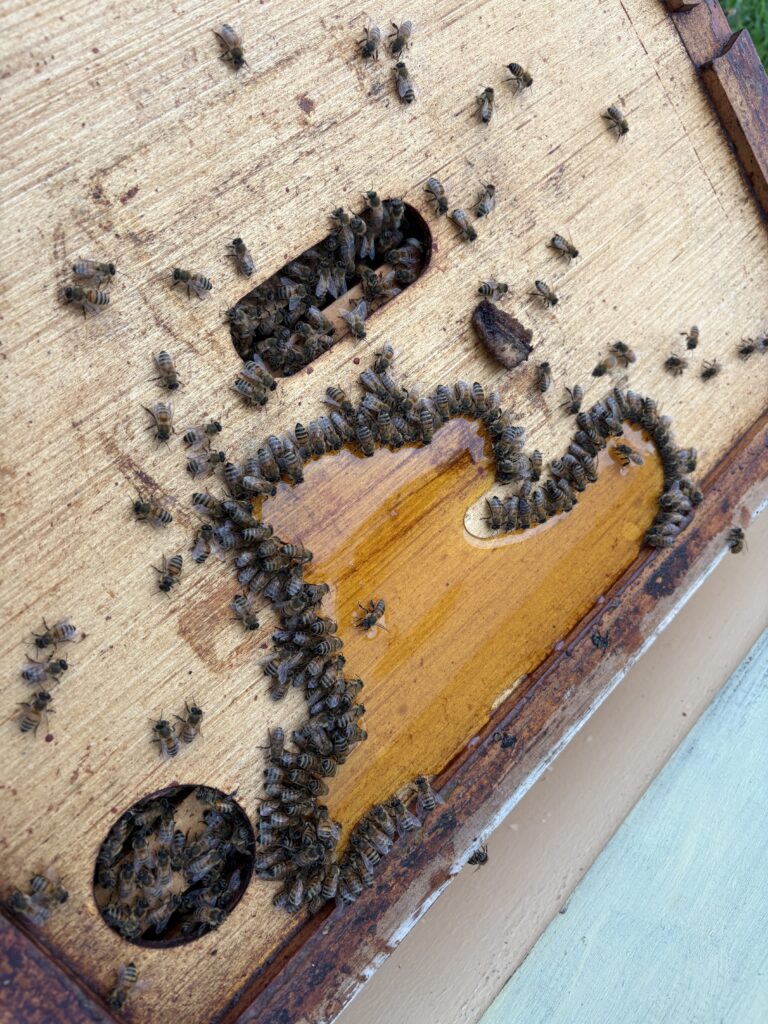
As a beekeeper, when you open a hive, you instantly know the condition of the hive just by listening to their sounds. By now, these bees seem to know me. I can open their hive bodies and they do not freak out on me most days. When there is a queen in a hive the bees are calm. It is hard to describe it any other way. In a complete hive they all know what to do. They are growing. There is a plan.
When the hive is not queen right and they are struggling with which way to go you know instantly. They seem frantic as they come up with a new plan. They seem to be buzzing for help. This is a time a beekeeper can help correct this for them if they can’t figure it out on their own. Not doing so will mean the death of the hive. All of the bees naturally know this.
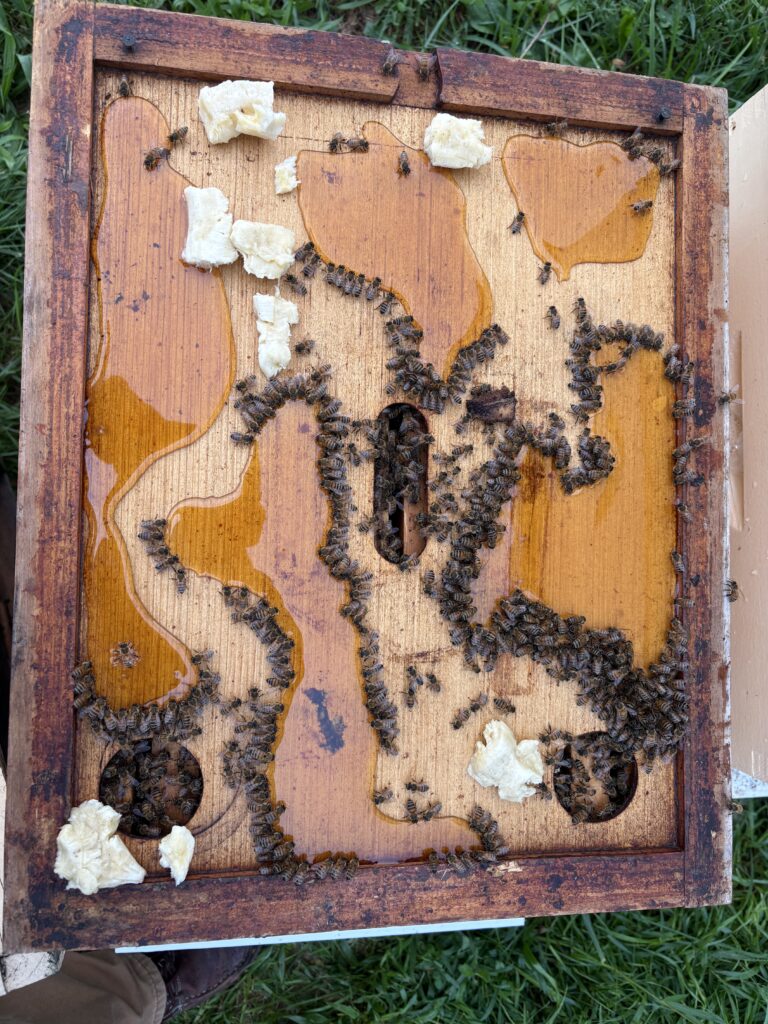
I call this my “baby hive”. The odds of long term survival are not in their favor. I had the most amazing experience with them during this time. When I opened the top cover they would all come out and look up at me and buzzing kind of half “ok” and half “what the hell are you doing”. But then I would pour in the raw honey. The hive went silent. No noise at all. It would end up being about ¼ to ½ quart of honey each time I fed them.
By the next feeding, it would all be gone. I did this until it got too cold to open the hive anymore.
One more small problem is they were about the size of a “nuc” (nucleus). A nuc is “just enough” bees to get a hive started in the spring. The odds of them making it through the winter were still very small. Honestly, I worried that trying to “help” them would only prolong the inevitable — that they might suffer anyway, whether I stepped in or not. Winters here are not friendly for the unprepared.
Then, three months of winter happened. And it was brutal. The coldest I can remember since living here the last 26 years. It is hard to describe how long these cold days can be here.
When the weather warms to about 50° the bees will come out of the hive to see the sun, poop and go back inside. I find the poop part interesting because when it is too cold to go outside they just hold it. But the second they can go outside there are little brown dots all over the snow. Maybe a little more information than this writing needs. That did happen a couple of times just before and after the coldest part of the winter.
On the first day of spring when the temperature would stay above 50° I went out to the hive. Not only had they survived but they have flourished. They were super active. The most active hive I have. They went from the smallest, weakest hive to my strongest hive.
The spring would still be brutal. We had a late hard frost that killed all the flowering plants early in the flowering spring. Every plant with flowers and soft leaves was killed in a freeze that lasted longer than 24 hours. It completely stopped the spring nectar flow.
At the time I didn’t think much of it but how bad it made things look when things would normally be busting out with life. But after checking the honey supers a month into spring I noticed the bees were struggling to collect honey. It was as if there was a dearth but there was abundance everywhere. There were still flowers but there was no honey. The bees were in “emergency” mode. They appeared to be slowing brood production and conserving everything. There was nothing “extra” to put in the supers.
Except one hive.
My baby hive had exploded. They needed another brood box. I added another brood box. They filled one honey super full. I added two more. I open their hive and do inspections and it is absolute chaos with bees everywhere. They have their old self-built comb along with the more human looking brood box on commercial frame board. The queen is laying eggs like crazy and the brood is perfectly distributed over every frame. Theirs is a “text book” hive.
But it is such a mystery to me. How did this hive go from almost dead to such perseverance?
There are many stories I could tell in this hive. But one of perseverance, persistence and giving back is the one that strikes me most. I could have left them alone. They would have died and the world around me wouldn’t have noticed. I could have combined them with another hive and moved on. That would have been the easiest thing to do.
None of my other hives are producing honey right now. Not a single one of them.
Had I not fed this hive I would have no honey this summer. They produced exactly two full super frames of perfectly capped and dried honey. It is my favorite honey (spring honey is very clear and light colored). That is my entire summer harvest.
This hive let me know that I have graduated as a full beekeeper. I no longer needed to ask others for help. The help they need is obvious to me now. I know what they are expecting of me. After years of apprenticeship I have finally arrived as a beekeeper. Thanks to this baby hive they allowed me to grow with them together.
In my wildest dreams I never thought a bug would have such an impact on my personal life. They have taught me more about being human than most humans I know. It is they who have shown how connected everything is. It is they who have shown me that small acts can make a big difference. For a while, I was their whole life.
This hive has shown me that what you give will be given back in abundance. They just needed a little help from a beekeeper.